
From Cells to Systems

Updated: May 3
HSC Biology | Free Study Notes
Understanding how cells form tissues, tissues form organs, and organs work together in systems helps explain how whole organisms stay alive and function efficiently.
In this lesson
how cells are organised in multicellular organisms
what tissues, organs and organ systems are
how each level of organisation has a specific role
why increasing organisation improves efficiency
how all levels work together in a whole organism
Why multicellular organisms need organisation
Multicellular organisms are made of many cells. These cells cannot all do exactly the same job if the organism is to survive efficiently.
As organisms become larger and more complex:
groups of similar cells work together
structures become organised into larger functional units
This creates a hierarchy of organisation.
The hierarchy from cells to systems
The basic order is:
cells → tissues → organs → organ systems → whole organism
Each level is built from the one before it.

Cells
Cells are the basic unit of life.
What cells do
In multicellular organisms, cells:
carry out specific functions
may be specialised for particular roles
work with other cells rather than acting alone
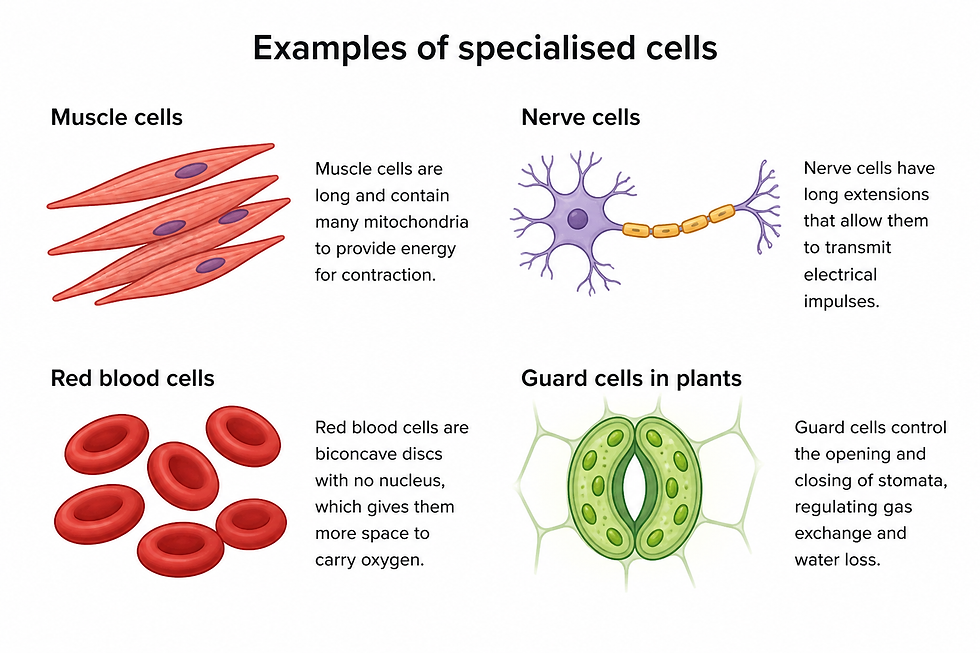
Examples of specialised cells
Examples include:
muscle cells
nerve cells
red blood cells
guard cells in plants
These cells are adapted to carry out different tasks.
Tissues
A tissue is a group of similar cells working together to perform a particular function.
Why tissues are important
Tissues allow many similar cells to cooperate, making processes more efficient than if each cell worked separately.
Examples of tissues
In animals:
muscle tissue
epithelial tissue
nervous tissue
In plants:
xylem tissue
phloem tissue
epidermal tissue
Organs
An organ is a structure made of different tissues working together to carry out a particular function.
Why organs are important
An organ is more complex than a tissue because it combines several tissue types in one structure.
Examples of organs
In animals:
heart
lungs
stomach
In plants:
leaf
root
stem
Key idea
A tissue performs one main type of job, while an organ combines different tissues to carry out a larger function.
Organ systems
An organ system is a group of organs working together to perform a major function for the organism.
Why organ systems are important
Organ systems allow large and complex organisms to:
transport materials
exchange gases
remove wastes
reproduce
coordinate body functions
Examples of organ systems
In animals:
digestive system
circulatory system
respiratory system
nervous system
In plants, students may also think in terms of systems such as:
root system
shoot system
Whole organisms
The whole organism is the complete living thing, made up of all its organ systems working together.
Why this level matters
No organ system works fully alone. The organism survives only because all systems interact and support one another.
For example:
the digestive system provides nutrients
the respiratory system provides oxygen
the circulatory system transports both
the excretory system removes wastes
Together, these keep the whole organism functioning.
How the levels are linked
Each level depends on the level below it.
Example in an animal
muscle cells
form muscle tissue
which is part of the heart, an organ
which works in the circulatory system
to support the whole organism
Example in a plant
specialised cells in xylem
form xylem tissue
which is part of the stem, root or leaf as an organ
which belongs to the shoot or root system
supporting the whole organism
Why this organisation is an advantage
Organisation in multicellular organisms gives several advantages.
Advantages
division of labour
greater efficiency
specialised functions
ability to grow larger and more complex
Limitation
The main limitation is interdependence. If one part fails, other parts may also be affected.
For example:
if an organ fails, the organ system may not work properly
if an organ system fails, the whole organism is affected
Tissues, organs and systems compared
Level | Definition | Example |
Cell | Basic unit of life | Muscle cell |
Tissue | Group of similar cells working together | Muscle tissue |
Organ | Different tissues working together | Heart |
Organ system | Group of organs working together | Circulatory system |
Whole organism | Entire living thing | Human |
Worked example
Exam-style question
Explain how cells, tissues and organs are related in a multicellular organism.
Worked answer
In a multicellular organism, specialised cells with similar structures and functions group together to form tissues. Different tissues then work together to form organs, which carry out larger and more complex functions.
Why this works
This answer:
follows the hierarchy clearly
uses the term specialised
links structure to function
Common mistakes
Mixing up tissues and organs.
Saying an organ is made of only one type of cell.
Forgetting that organ systems are made of several organs.
Treating plant organisation and animal organisation as completely unrelated.
Listing the hierarchy without explaining that each level works together.
Quick quiz
What is the correct order from smallest to largest level of organisation?
What is a tissue?
What is an organ?
Give one example of an organ system in an animal.
Why is organisation important in multicellular organisms?
Comments